Industrial & Commercial Water Heaters: A Buyer’s Guide to Superior Quality
Why the Right Industrial Water Heater Can Make or Break Your Operation
An industrial water heater is a high-capacity hot water system designed to meet the demanding, continuous hot water needs of manufacturing plants, food processing facilities, hospitals, military installations, and other heavy-use environments — far beyond what any residential or standard commercial unit can handle.
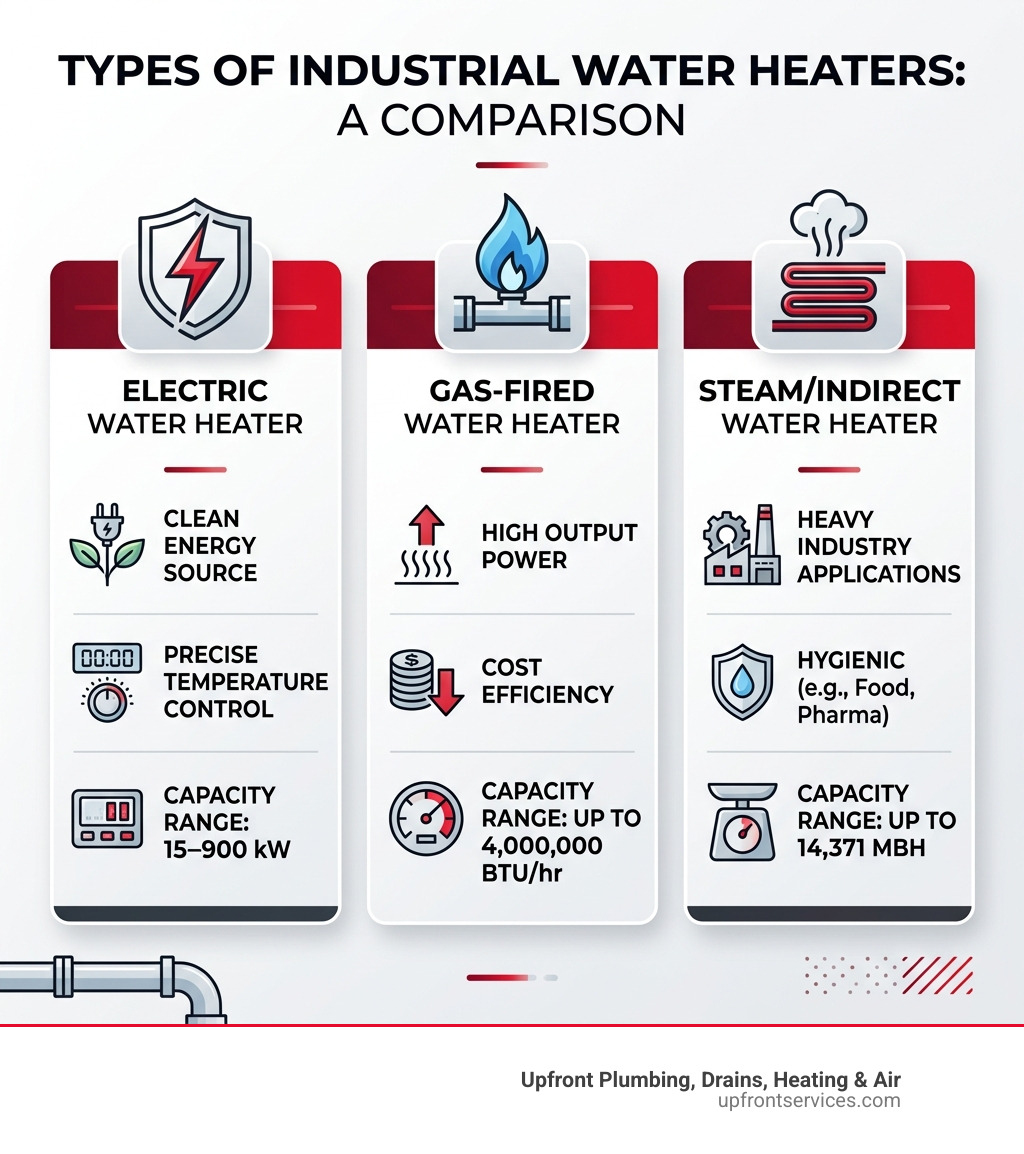
Here are the main types of industrial water heaters at a glance:
| Type | Best For | Capacity Range |
|---|---|---|
| Electric | Precise temperature control, clean energy | 15–900 kW |
| Gas-Fired | High output, cost efficiency | Up to 4,000,000 BTU/hr |
| Steam/Indirect | Heavy industry, pharmaceutical, food processing | Up to 14,371 MBH |
| Tankless | Continuous flow, space-saving | 5–144 kW |
| Heat Pump | Energy efficiency, low operating costs | Varies |
These systems are built for reliability under pressure — literally. They carry ASME certifications, handle storage volumes from 1 to 10,000 gallons, and are engineered to run around the clock without failure.
Without a properly sized and maintained industrial water heater, operations grind to a halt. As one industry source puts it: lower productivity, longer timetables, and lost revenue follow quickly when hot water isn’t available on demand.
I’m Ryan Jonas, a results-driven process improvement specialist with hands-on experience optimizing industrial water heater systems and facility-wide heating solutions. In this guide, I’ll walk you through everything you need to choose the right system for your operation with confidence.
Understanding the Core Types of Industrial Water Heater Systems
When we talk about an industrial water heater, we aren’t just talking about a bigger version of the tank in your basement. These are sophisticated machines engineered for specific thermodynamic tasks. Whether you are running a massive laundry facility in Salt Lake City or a food processing plant in West Valley City, the heating method you choose dictates your operational costs for the next twenty years.
Electric Boilers and Heaters
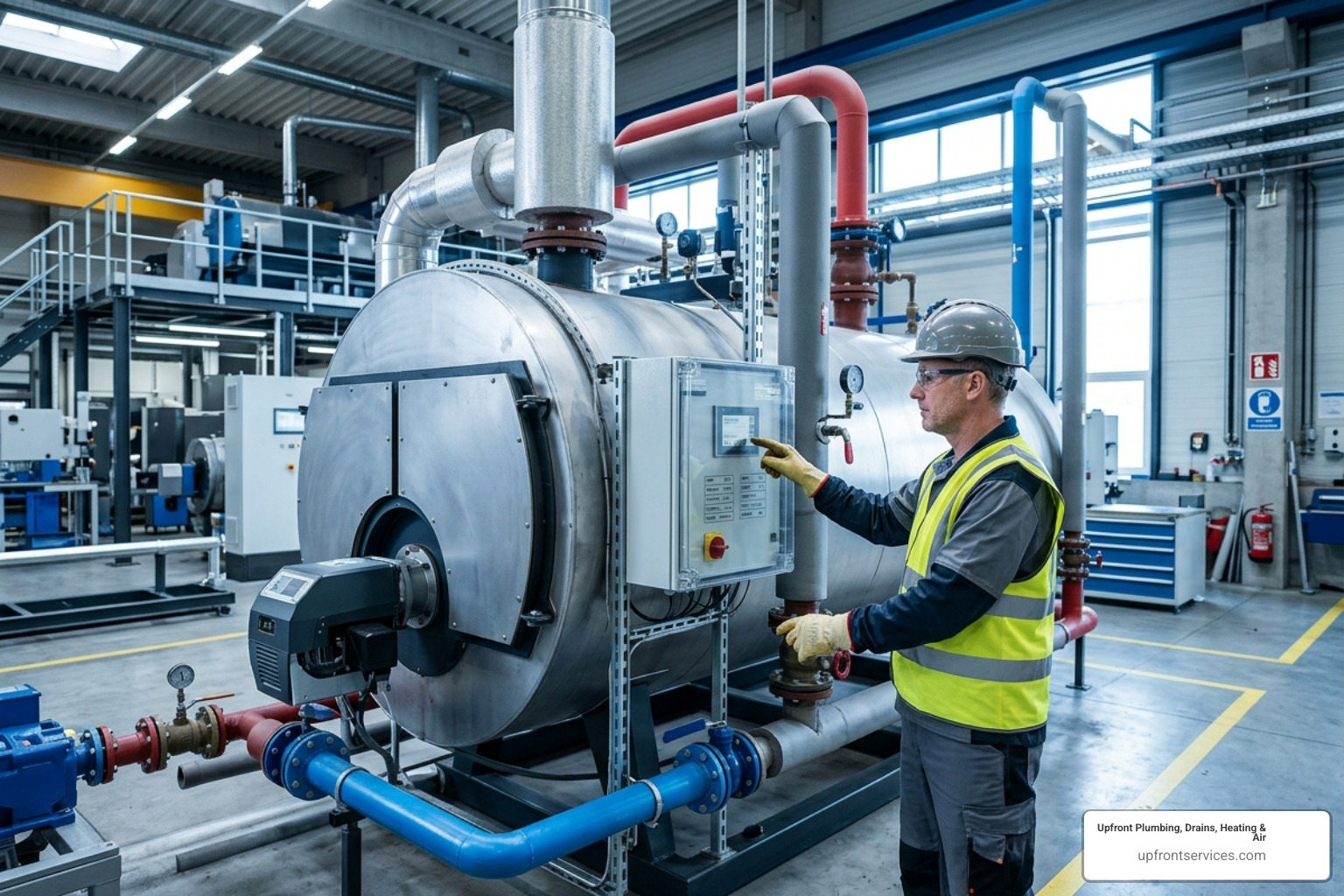
Electric models are prized for their “clean” operation. They don’t require venting for exhaust gases, making them easier to place in tight spaces or underground levels. Modern units, like the HW Electric Hot Water Boiler | Thermon | Industrial Heating Solutions, offer massive power ranges from 200 to over 4,200 kW. These systems use Incoloy-sheathed elements to resist corrosion and provide precise temperature regulation via sensors located directly in the outlet pipe.
Gas-Fired Units
Gas remains the heavyweight champion for high-volume demand. With outputs reaching up to 4,000,000 BTU/hr, gas systems can heat thousands of gallons per hour. These are often the go-to for facilities where fuel cost is the primary driver of the bottom line.
Indirect Fired and Steam-Based Heating
In many heavy industrial settings, the facility already has a steam boiler for process work. An Indirect Fired Water Heater | Thermon | Industrial Heating Solutions uses that existing steam (or hot water) to heat the domestic or process water through a heat exchanger. This prevents the “clean” water from ever touching the “dirty” heating medium, ensuring purity and efficiency. If your current boiler is struggling, it might be time to look into professional boiler replacement services to ensure your primary heat source is up to the task.
Advantages of Gas-Fired vs. Electric industrial water heater Models
The choice between gas and electric usually comes down to infrastructure and utility rates.
- Gas-Fired Advantages: Generally offers lower operational costs. Some high-efficiency gas models can save up to 40% on utility costs compared to older steam-based systems. They are capable of massive BTU outputs, making them ideal for large-scale facilities.
- Electric Advantages: Lower installation costs because there is no need for complex venting or gas lines. They offer a smaller carbon footprint if powered by renewables and provide incredibly precise temperature control (often within +/- 1°F).
The Role of Steam and Indirect Heating in Heavy Industry
In sectors like pharmaceuticals or data centers, reliability is everything. Systems like the Sioux WH Series Water Heaters – 1.0 to 5.0 Million BTU/Hr Water Heaters | Sioux Corporation are designed to provide a continuous supply of hot water within minutes of startup. These often feature copper tube bundles for superior heat transfer and dual-section functionality, allowing the unit to handle both steam and hot water as heating mediums. This versatility is crucial for plants that shift their energy sources based on seasonal availability.
Key Differences Between Commercial and Industrial Water Heaters
It is a common mistake to use the terms “commercial” and “industrial” interchangeably. In our experience serving Bountiful and Sandy, we’ve seen commercial units fail prematurely because they were pushed into industrial roles.
| Feature | Commercial Water Heater | Industrial Water Heater |
|---|---|---|
| Storage Volume | Typically 20–120 gallons | 150 to 10,000+ gallons |
| BTU Input | 75,000 to 399,000 BTU | 400,000 to 4,000,000+ BTU |
| Construction | Standard steel with glass lining | ASME-stamped heavy-duty vessels |
| Lifespan | 6–10 years in heavy use | 15–25+ years with maintenance |
| Customization | Limited “off-the-shelf” options | Fully modular/skid-mounted packages |
Industrial units, such as the Dura Power XL Water Heater | A.O. Smith Industrial Solutions, are built with progressive energizing elements. This means the heater “clocks” the elements, rotating which ones turn on first to ensure equal wear and tear across the system. For a deeper look at the transition from standard units, you can learn more about commercial water heaters on our specialized service page.
Matching Storage Capacity to Industrial Demand
In a hotel in Park City, demand peaks in the morning. In a manufacturing plant in West Jordan, demand might be constant 24/7.
- Peak Flow Rates: We calculate the “Gallons Per Hour” (GPH) recovery rate to ensure you never run out.
- Buffer Tanks: For systems with massive “dump” loads (like cleaning a fleet of trucks), we use large buffer tanks—sometimes up to 10,000 gallons—to store energy during low-use periods.
Durability and Material Standards for High-Purity Applications
Standard water heaters use glass-lined steel. However, for high-purity applications like Reverse Osmosis (RO) or Deionized (DI) water systems, standard materials will literally dissolve.
- 316L Stainless Steel: This is the gold standard for corrosion resistance. It is essential for pharmaceutical and food-grade applications.
- Incoloy Elements: These heating elements are designed to withstand the aggressive nature of ultra-pure water.
- Specialized Solutions: Companies like those featured at Sioux Water Heaters | Industrial Water Heaters provide stainless steel wetted parts specifically for corrosive environments or specialized chemical heating.
Critical Factors for Selecting an industrial water heater
Choosing the right industrial water heater requires looking past the price tag and focusing on the Total Cost of Ownership (TCO). In Utah’s climate, where temperatures can swing wildly, your system needs to be robust.
Fuel Source and Space Constraints
If you are retrofitting a facility in Centerville or Layton, space is often at a premium. Tankless or semi-instantaneous models can save hundreds of square feet. However, you must also consider venting. High-efficiency gas units produce cooler exhaust, which allows for plastic (PVC/CPVC) venting, but they require a drain for the acidic condensate they produce. For large-scale projects, sourcing parts from a reliable supplier like Ferguson: Plumbing Supplies, HVAC Parts, Pipe, Valves … is often necessary to find specialized venting components.
Energy Efficiency and Condensing Technology
Modern condensing technology has changed the game. By capturing the heat that used to go up the chimney, these units achieve up to 98% thermal efficiency.
- 20:1 Turndown Ratio: This allows the heater to fire at only 5% of its capacity during low-demand periods, preventing “short-cycling” and saving massive amounts of fuel.
- Low NOx Emissions: Especially important for staying compliant with environmental regulations, these burners produce fewer nitrogen oxides.
To keep these high-tech systems running at peak efficiency, we highly recommend professional HVAC maintenance services, as the sensors and burners in condensing units require specialized calibration.
Advanced Controls and Smart Integration
The days of a simple dial thermostat are over. Modern industrial systems feature:
- Digital Control Valves: Maintaining temperatures within +/- 1°F.
- VFD Pump Assemblies: Variable Frequency Drives adjust pump speed based on demand, drastically reducing electricity use.
- BMS Integration: Using Modbus or BACnet, your water heater can “talk” to your building management system, allowing for remote monitoring and troubleshooting.
- Remote Connectivity: Systems like Sioux Sentinel Pro allow manufacturers to troubleshoot your unit from halfway across the country, reducing downtime.
Maintenance, Compliance, and Longevity Features
An industrial water heater is an investment. In Utah, our water is notoriously hard. Without proper care, your shiny new system will become a very expensive lime-deposit collector within a few years.
Scaling and Maintenance for Your industrial water heater
Hard water causes “scale”—a rock-hard mineral buildup on heating elements and tank walls.
- Nanobubble Generators: A cutting-edge technology that uses microscopic bubbles to physically remove existing scale and prevent new buildup without harsh chemicals.
- Kettling Noises: If your heater sounds like a tea kettle or a giant popcorn popper, that’s the sound of water trapped under layers of sediment. It’s a sign of massive efficiency loss and impending tank failure.
- The Professional Edge: While a simple flush helps, industrial systems often require professional descaling. If your system is already showing signs of stress, don’t wait for a total shutdown; check out our HVAC Repair and Boiler Repair services to get ahead of the problem.
Safety Standards and Regulatory Compliance
Industrial units must meet strict codes to ensure they don’t become a safety hazard.
- ASME HLW Stamp: This ensures the pressure vessel was built to the highest safety standards in the world.
- T&P Relief Valves: These are the “safety fuses” of your heater. In industrial settings, these are typically rated for 150 psi and 210°F.
- Regional Compliance: In areas like Salt Lake City, we ensure all installations meet local Low NOx and drinking water compliance (lead-free) standards.
Frequently Asked Questions about Industrial Water Heating
What is the difference between an industrial and commercial water heater?
The primary difference is the duty cycle and construction. Commercial heaters are designed for businesses like restaurants or small apartment buildings with intermittent high demand. Industrial water heaters are designed for 24/7 continuous operation, often featuring thicker steel, ASME certifications, and modular components that can be serviced without shutting down the entire system.
How does a nanobubble generator reduce maintenance costs?
Nanobubble generators work by injecting billions of nano-sized bubbles into the water stream. These bubbles create a physical scrubbing action and change the way minerals like calcium carbonate behave, preventing them from bonding to the heating elements. This can reduce the frequency of manual descaling by 50% or more, extending the life of the unit and maintaining high thermal efficiency.
Why is 316L stainless steel preferred for deionized water systems?
Deionized (DI) water is “hungry” water. Because its minerals have been removed, it is chemically aggressive and will pull ions out of standard metals, leading to rapid pitting and corrosion in copper or standard steel. 316L stainless steel has a specific molybdenum content that makes it resistant to this “leaching” process, ensuring the water stays pure and the tank stays intact.
Conclusion: Partnering with the Experts
Selecting and installing an industrial water heater is a complex undertaking that requires more than just a plumber—it requires a partner who understands the high-stakes nature of industrial operations. At Upfront Plumbing, Drains, Heating & Air, we bring over 25 years of experience to every project across the Wasatch Front, from Ogden down to Provo.
We specialize in customized heating solutions that prioritize operational reliability and energy efficiency. Whether you need a turnkey installation of a 4-million BTU gas system or a precision-controlled electric boiler for a laboratory, our team provides honest, upfront pricing and quality work backed by unmatched warranties.
Don’t let a failing water system stall your production. Schedule your industrial water heater consultation today and let us help you optimize your facility for the long haul.