The Ultimate Guide to Backflow Prevention Inspections
What Is a Backflow Prevention Inspection?
Backflow prevention inspection is the annual testing of a backflow prevention assembly to confirm it stops contaminated water from flowing backward into your clean drinking water supply.
Here’s what you need to know at a glance:
- What it is: A certified tester checks your backflow preventer for proper function using pressure gauges and test cocks
- Who needs it: Most commercial properties, irrigation systems, fire suppression lines, and many multi-unit residential buildings
- How often: Once per year, plus after any installation, repair, or relocation
- Who performs it: A licensed, certified backflow prevention tester — not just any plumber
- What happens if you skip it: Fines, water service disconnection, or worse — contaminated drinking water
Your drinking water flows in one direction: from the public main into your property. That’s how it’s supposed to work.
But pressure changes — from a water main break, heavy demand, or equipment on your property — can flip that flow in reverse. When that happens, anything in your pipes can enter the public water supply. Fertilizer. Bacteria. Chemicals. That reversal is called backflow, and it’s a serious public health risk.
A backflow prevention device is your first line of defense. But like any mechanical component, it can wear out, corrode, or fail silently. That’s exactly why regular backflow prevention inspection exists — to catch failures before they become a contamination event.
I’m Ryan Jonas, a results-driven operations and management specialist with experience in process improvement and compliance-driven service industries, including backflow prevention inspection programs. I’ll walk you through everything you need to know to stay safe and compliant.
The Importance of a Backflow prevention inspection
When we talk about backflow, we are talking about a major public health hazard. Your home or business is connected to a vast network of pipes that supply clean, potable water. However, that same system is often connected to things that are decidedly not clean—like irrigation systems filled with fertilizer, boilers containing chemicals, or fire suppression lines where water has sat stagnant for years.

Without a functional backflow preventer, a sudden drop in city water pressure can act like a giant straw, sucking those contaminants straight into the drinking supply. This is why a backflow prevention inspection is not just a “suggestion” by the city; it is a legal requirement designed to keep our community safe.
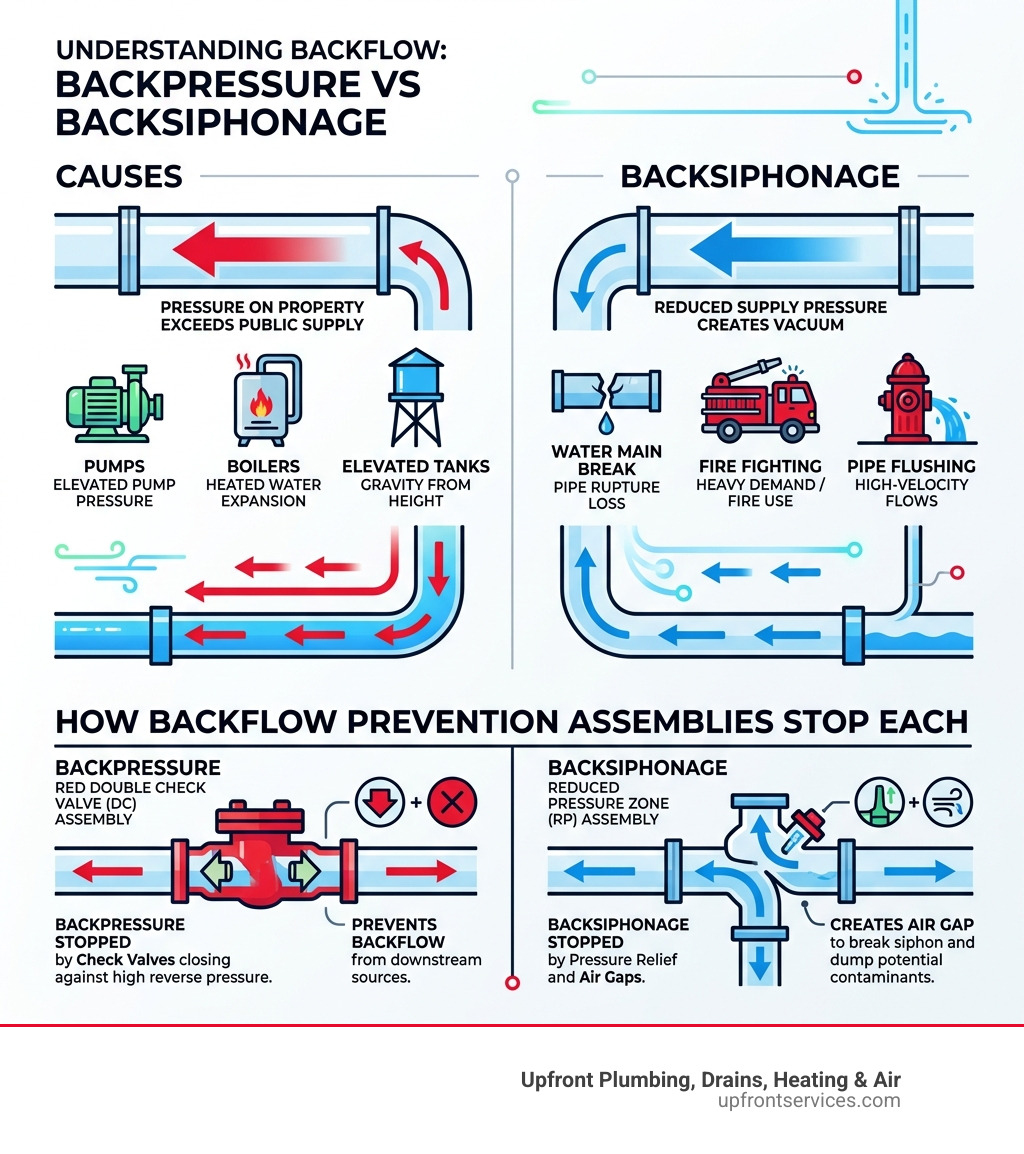
Backpressure vs. Backsiphonage
To understand why inspections are so critical, we have to look at the two ways backflow happens:
- Backpressure: This occurs when the pressure in your private plumbing system becomes higher than the pressure in the public water main. This can be caused by pumps, boilers, or even heat expansion in your water heater. If your system is “pushing” harder than the city is, your water (and whatever is in it) goes back into the main.
- Backsiphonage: This is more common and happens when there is a sudden drop in the city’s water pressure. Think of a water main break down the street or a fire hydrant being opened for an emergency. This creates a vacuum effect that pulls water backward from your property.
Common Contamination Sources
In our experience across Boise, we see several high-risk “cross-connections” that require constant monitoring:
- Irrigation Systems: These are often the biggest culprits. Pesticides, fertilizers, and animal waste can pool around sprinkler heads and get sucked back into the house.
- Boilers and HVAC: Chemicals used to prevent corrosion in heating systems are toxic if ingested.
- Fire Sprinkler Lines: Stagnant water in these pipes can grow dangerous bacteria like Legionella.
- Pools and Hot Tubs: Chlorine and other cleaning chemicals must stay out of the drinking water.
For more information on keeping your entire system running smoothly, check out our general plumbing services. You can also find detailed regulatory information on Cross Connection Control and Backflow Prevention through the Utah Department of Environmental Quality.
What Happens During a Backflow prevention inspection?
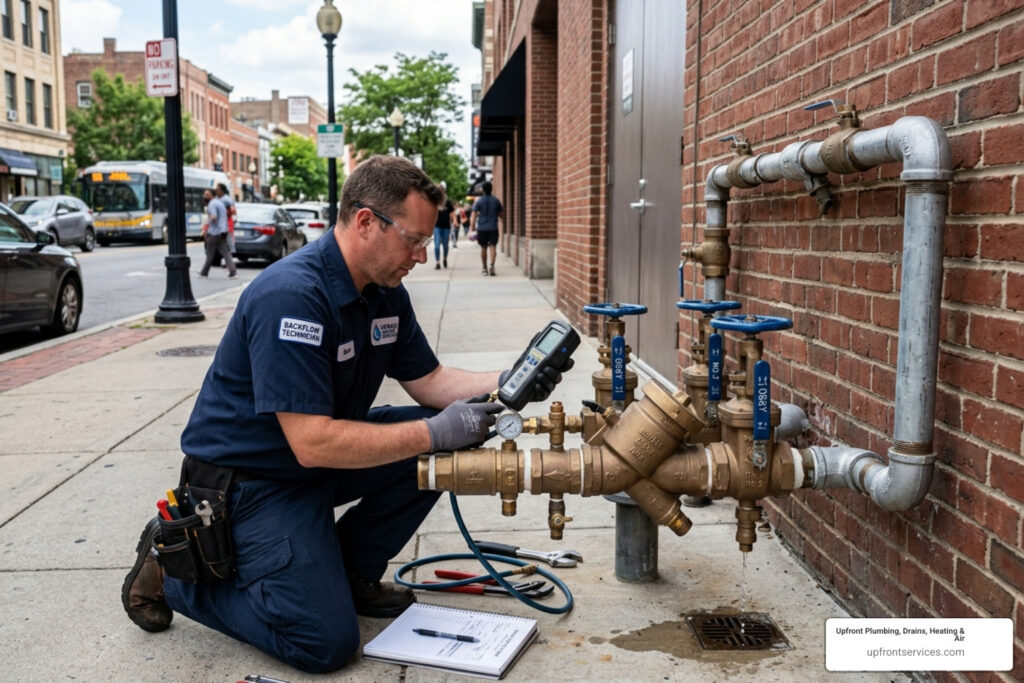
If you’ve never seen a backflow prevention inspection in action, it might look like a lot of technical wizardry. In reality, it’s a very precise, step-by-step mechanical test.
A typical inspection involves:
- Visual Assessment: We check the device for cracks, corrosion, or illegal bypasses. We also ensure it’s installed in the correct orientation (some devices can’t be installed vertically, for example).
- Test Cocks and Gauges: The assembly has small ports called “test cocks.” We attach a calibrated differential pressure gauge to these ports to measure exactly how much pressure the internal check valves are holding.
- Functional Testing: We simulate backflow conditions to ensure the valves close tightly. If it’s a Reduced Pressure Zone (RPZ) device, we make sure the relief valve “dumps” water as it’s supposed to when a failure is detected.
- Reporting: Once the test is complete, we provide a report. If it passes, we submit the results to the local water authority.
For a look at how other districts handle these requirements, you can see the standards used by the Portland Water District, which mirror many of the rigorous steps we take here in Idaho.
Preparing Your Property for Inspection
To make the process go as smoothly as possible, there are a few things property owners should do:
- Water Shut-off: Be prepared for the water to be turned off for about 30 to 60 minutes. If you are a business, schedule this during off-hours or low-activity times.
- Clear Access: Ensure the technician can actually get to the device. If it’s buried under a pile of boxes in a basement or hidden behind overgrown bushes in the yard, it will take longer (and potentially cost more).
- On-site Documentation: Have your previous test reports or the notice letter from the city ready. This helps us ensure we are testing the right assembly and reporting to the correct department.
If you’re worried about the state of your pipes before an inspection, our drain cleaning experts can help ensure your system is clear and ready for testing.
Types of Backflow Prevention Assemblies and Devices
Not all backflow preventers are created equal. The type of device required depends entirely on the “hazard level” of your property.
1. Reduced Pressure Zone (RPZ) Assembly
The RPZ is the “Gold Standard” of backflow prevention. It consists of two independent check valves and a relief valve in the middle. If either check valve fails, the relief valve opens and dumps water onto the floor (or into a drain), physically preventing any backflow. These are required for “high-hazard” situations like car washes, hospitals, and any system with chemical additives.
2. Double Check Valve (DC) Assembly
A DC assembly uses two spring-loaded check valves. It is generally used for “low-hazard” applications where backflow would be a nuisance (like bad-tasting water) but not necessarily a health crisis. In many regions, these are used for indoor fire sprinkler systems that don’t use chemicals.
3. Pressure Vacuum Breaker (PVB)
Commonly found on the side of residential homes in Bountiful, Layton, and Sandy, the PVB is designed specifically for irrigation systems. It uses a floating disc to allow air into the system if a vacuum occurs, breaking the siphon. It must be installed at least 12 inches higher than the highest sprinkler head to work correctly.
4. Air Gaps
The simplest form of backflow prevention is a physical air gap. Think of the space between your kitchen faucet and the rim of the sink. Because there is a physical gap of air, water cannot possibly jump back up into the faucet.
| Device Type | Hazard Level | Common Use Case | Requires Annual Test? |
|---|---|---|---|
| RPZ | High | Commercial, Medical, Boilers | Yes |
| DC | Low | Fire Lines (No Chemicals) | Yes |
| PVB | High/Medium | Lawn Irrigation | Yes |
| Air Gap | High | Sinks, Tanks | No (Visual Only) |
If your system is old and uses outdated galvanized pipes that are corroding, you might need more than just a new valve. Learn more about our repiping services to ensure your whole system is up to code.
Choosing the Right Device for Your System
Choosing the wrong device can lead to a failed backflow prevention inspection before you even start. The local plumbing code and your water purveyor determine what is required. For example, if you have a lawn with a slope, a PVB might not be enough, and you may need an RPZ. You can find more about how different cities categorize these risks in the Fort Worth Backflow guide, which outlines 18 specific circumstances where protection is mandatory.
Legal Requirements and Annual Testing Mandates
In Boise, backflow prevention is not just a city ordinance; it is governed by state law under the Utah Department of Environmental Quality. Every commercial property and many residential properties are required to have their assemblies tested annually.
Who Needs Annual Testing?
- Commercial & Industrial: All businesses are generally required to test annually.
- Multi-Unit Residential: Buildings with 9 or more units almost always require testing, while smaller units (3-8) may be exempt depending on the local hazards.
- Irrigation Systems: If you have a dedicated irrigation line, it must be tested every year, usually in the spring when you turn the water on.
- Fire Suppression: These systems are critical for safety and must be tested to ensure the stagnant water doesn’t contaminate the domestic supply.
While we focus on Idaho, similar strict mandates exist nationwide. For instance, the City of Boulder tracks thousands of assemblies and issues heavy fines for non-compliance. Our local municipalities in Boise and surrounding counties are just as diligent.
Failure to comply with these mandates can result in:
- Fines: These can range from $50 to over $1,000 depending on the duration of non-compliance.
- Water Service Disconnection: The city has the right to shut off your water to protect the public supply if you refuse to test your device.
- Liability: If a backflow event occurs on your property and someone gets sick, the legal and financial consequences are astronomical.
Keep your water safe and hot! If you’re upgrading your system, check out our water heater services.
Who Can Perform a Backflow prevention inspection?
You cannot just have a “handyman” or even a standard plumber perform this test. In Utah, the person must be a Certified Backflow Assembly Tester.
- Certification: Testers must complete a rigorous 40-hour course and pass both a written and practical exam.
- Registration: Testers must be registered with the state and often with the specific city where they are working.
- Equipment: Testers must use a differential pressure gauge that is calibrated annually to ensure accuracy.
The City of Davis maintains a list of certified testers, much like our local Idaho water districts do, to ensure only qualified pros are touching the public water supply.
Submitting Test Reports and Maintaining Compliance
Once we finish your backflow prevention inspection, the work isn’t done. The report must be submitted to the correct authority. Many cities now use online portals like Vepo Envirotrax or The Compliance Engine.
- Deadlines: Most cities give you a 30-to-60-day window from the date of your notice letter to complete the test.
- Record Keeping: You should keep a copy of your test reports for at least three years.
- Notifications: If your device fails, we are often required to notify the city within 24 hours.
The Nashville Building Permits Central process is a great example of how these inspections are tied directly to building permits and Certificate of Occupancy—showing just how seriously the government takes this process.
Troubleshooting Failures and Inspection Costs
It’s the news no property owner wants to hear: “Your backflow preventer failed.” But don’t panic. Most failures are caused by simple, fixable issues.
Common Reasons for Failure
- Debris: A small pebble or bit of rust can get stuck in a check valve, preventing it from sealing tightly.
- Worn Seals: The rubber seals inside the device can crack or become brittle over time. Most devices last 5 to 10 years, but the internal “guts” may need replacing sooner.
- Mineral Buildup: In Idaho, our hard water can lead to calcium deposits that interfere with moving parts.
- Spring Fatigue: The springs that hold the valves shut can lose their tension over time.
The 30-Day Window
If your device fails, you typically have 30 days to have it repaired or replaced and re-tested. We always carry common repair kits on our trucks to try and fix the issue on the spot, saving you a second service call. If your main line is the issue, you might also need to look into sewer repair to ensure your entire waste and supply system is healthy.
How Much Does it Cost?
The cost of a backflow prevention inspection varies based on a few factors:
- Device Size: Testing a 1-inch residential PVB is generally cheaper than testing a 6-inch commercial RPZ.
- Accessibility: If the device is in a confined space or requires a ladder, the price may increase.
- Number of Devices: Most companies (including us!) offer discounts if you have multiple assemblies on the same property.
- Repairs: If the device fails, the cost of parts and labor for the repair is additional.
On average, a standard residential or small commercial test in the Boise area ranges from $85 to $150, plus any applicable city filing fees.
Frequently Asked Questions about Backflow
How often must backflow prevention assemblies be tested?
In almost all cases, they must be tested annually. You must also test them immediately after installation, any time they are repaired or moved, and occasionally if there has been a major change to the plumbing system.
What are the penalties for non-compliance?
Penalties vary by city. In some areas, you’ll face a “hangtag” fee (around $50-$60) just for a late notice. If you continue to ignore the requirement, the city can shut off your water and charge a “reconnection fee” of $250 or more, plus the cost of the test and any fines.
Do single-family residential homes need backflow inspections?
Usually, no—unless you have a specific hazard. If you have an in-ground sprinkler system, a swimming pool, a private well, or a boiler, you likely have a backflow preventer that needs annual testing. Most modern homes in Idaho have a PVB for their sprinklers that requires a yearly check.
Conclusion
A backflow prevention inspection might feel like just another item on your “to-do” list, but it’s the only thing standing between your family’s drinking water and a cocktail of lawn chemicals and bacteria. At Upfront Plumbing, Drains, Heating & Air, we take that responsibility seriously.
With over 25 years of experience serving Boise, Meridian, Nampa and Caldwell we provide honest, upfront pricing and expert service. We don’t just “test and leave”—we make sure you are fully compliant with city codes and that your water stays safe.
Don’t wait for a notice from the city or a drop in water quality. Schedule your professional backflow prevention inspection today and breathe easy knowing your water is protected by the best in the business.