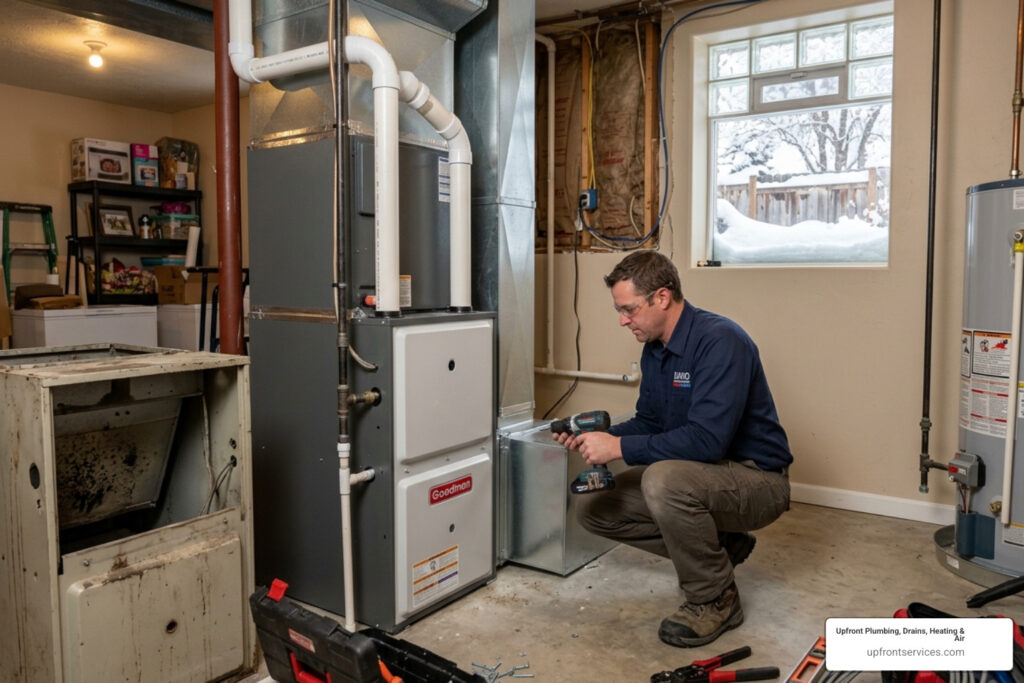
When to Replace Your Boise Furnace Before It Quits
Is It Time for Furnace Replacement in Boise Before Winter Hits?
Furnace replacement Boise homeowners need most often comes down to a few clear signals — and catching them early can save you thousands.
Here’s a quick answer if you’re deciding right now:
When to replace your Boise furnace:
- Your furnace is 15–20 years old or older
- Repair bills are climbing past $650 per visit
- Your energy bills keep rising with no clear reason
- Your home has cold spots or uneven heating
- You notice strange noises, soot, or a yellow pilot light
- Parts for your model are no longer available
Typical 2026 replacement costs in Boise:
| System Level | Estimated Cost |
|---|---|
| Entry-level | ~$5,000 |
| Mid-range | ~$8,500 |
| Premium | $12,000–$14,000 |
Boise winters are no joke. Temperatures average as low as 24°F, and a furnace that’s limping along is a real risk to your family’s comfort — and safety. The average furnace repair bill tops $650, and once repairs start stacking up, replacement almost always makes more financial sense than patching an aging system.
This guide walks you through exactly when to replace, what it costs, and what to expect from the process — so you can make a confident decision without second-guessing yourself.
Upfront brings results-driven expertise and a cost-effective, process-focused approach to every furnace replacement Boise project — helping Treasure Valley homeowners get reliable heating without the runaround. Read on to find out what signs to watch for and how to plan your replacement the right way.
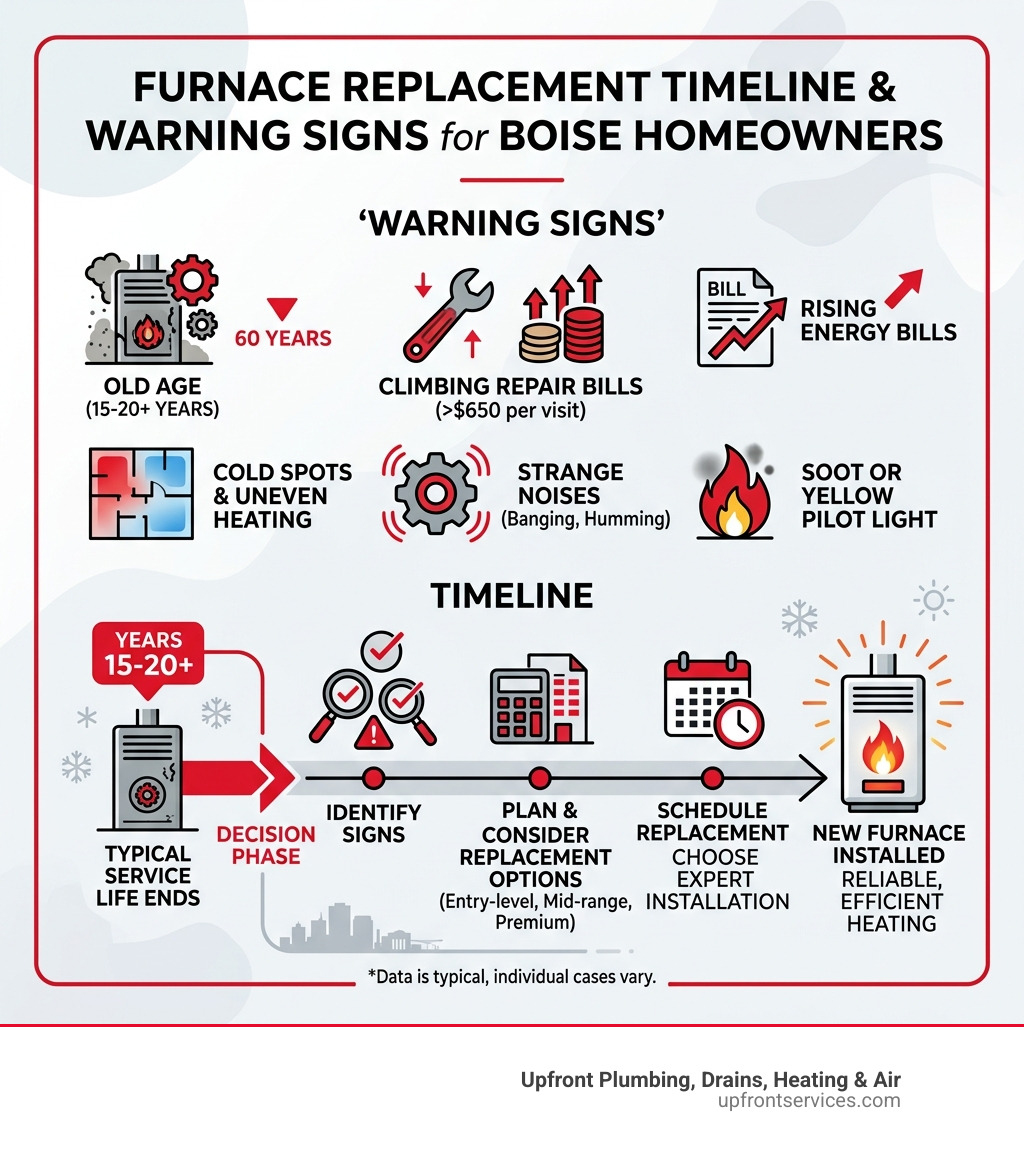
7 Warning Signs You Need Furnace Replacement Boise
Knowing when to pull the trigger on a new heating system can feel like a guessing game. However, your furnace usually leaves a trail of breadcrumbs before it finally gives up the ghost. In our experience across the Treasure Valley, if you are experiencing more than two of the following signs, it is time to stop searching for HVAC Repair and start looking at replacement options.
- The Age Factor: Most furnaces have a service life of 15 to 20 years. If yours was installed before 2011, it is likely operating at a fraction of its original efficiency.
- The $650 Rule: The average furnace repair bill in Boise now exceeds $650. If you’re facing a repair that costs 50% of the value of a new unit—or if you’ve had multiple repairs in the last two years—investing that money into a new system is the smarter financial move.
- Skyrocketing Utility Bills: Have you noticed your gas or electric bills creeping up even though the weather hasn’t been unusually cold? An aging furnace has to work much harder to produce the same amount of heat, “bleeding” money every month.
- Strange Noises: Furnaces should be relatively quiet. If you hear banging, popping, rattling, or screeching, it’s a sign of mechanical fatigue or a cracked component.
- The Yellow Pilot Light: A healthy furnace flame is crisp and blue. A yellow or flickering flame is a major red flag. It indicates that the fuel is not burning completely, which can lead to the production of carbon monoxide—a colorless, odorless, and deadly gas.
- Excessive Soot and Dust: If you find yourself dusting your furniture every other day or notice black “soot” marks around your registers, your furnace is struggling with combustion and likely blowing dirty air through your home.
- Frequent Cycles: If your furnace turns on and off every few minutes (short cycling), it’s a sign that the system is failing to maintain the temperature or is overheating internally.
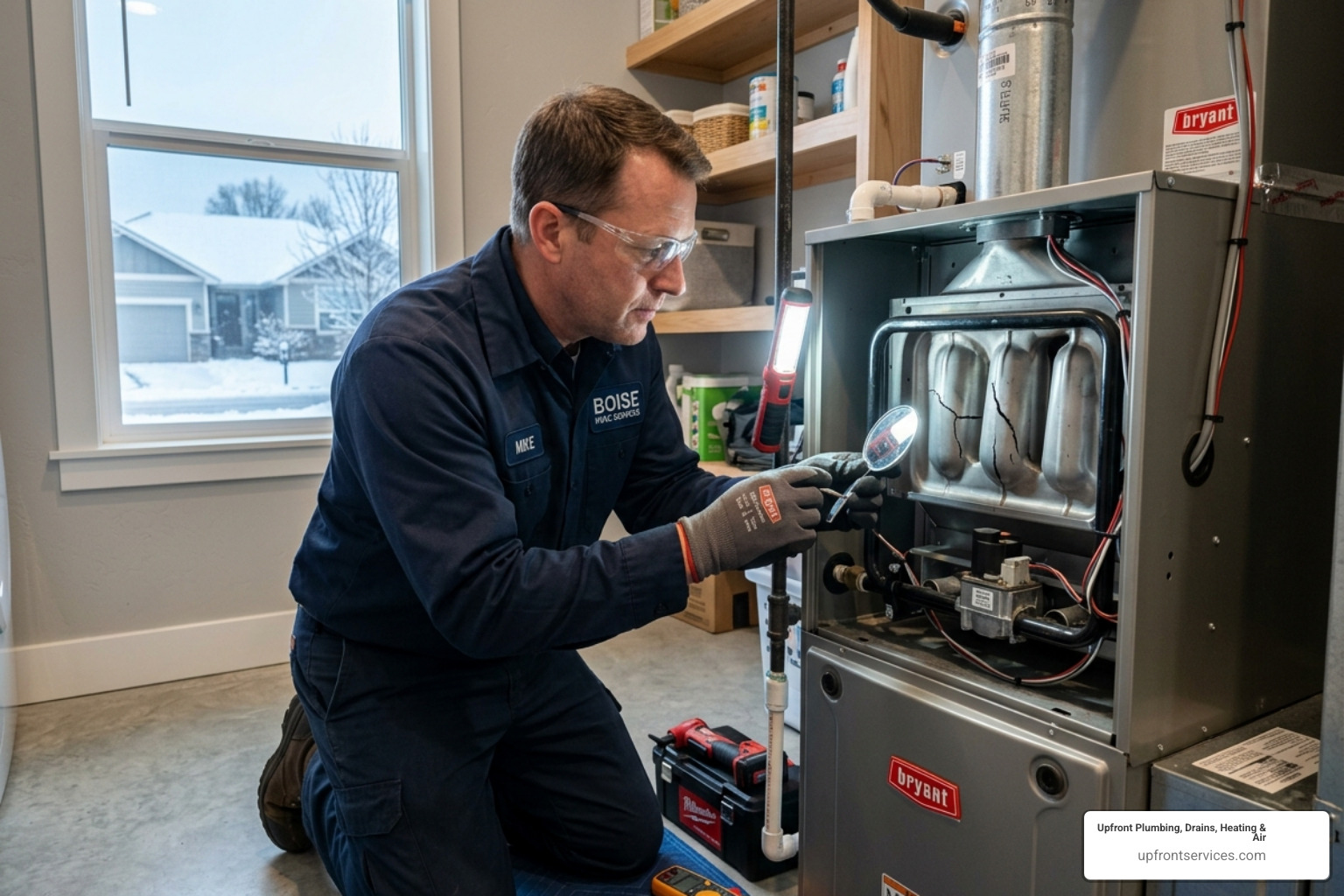
Identifying Inconsistent Heating and Short Cycling
One of the most frustrating signs of a failing unit is “The Boise Bedroom Chill.” You know the feeling—the living room is a balmy 72 degrees, but the back bedroom feels like an ice box. Inconsistent heating is a primary indicator that your furnace’s blower motor or heat exchanger can no longer push air effectively through your Boise, ID home.
Short cycling is equally problematic. When a furnace shuts off before the home reaches the thermostat setting, it puts immense strain on the ignition system and the motor. This usually happens because the system is overheating due to a cracked heat exchanger or failing sensors. Not only does this waste energy, but it also prevents your home from ever feeling truly comfortable.
Health and Safety Concerns with Aging Units
Beyond just comfort, your furnace plays a massive role in your family’s health. Older units often struggle to manage moisture levels. In the dry Idaho winters of Meridian, ID, a failing furnace can lead to excessively dry air that causes itchy skin, sore throats, and static shocks.
More seriously, poor indoor air quality (IAQ) is often linked to old furnaces that can no longer filter out dust, pollen, and pet dander. If your family is suffering from increased allergies or respiratory issues, it might be time to look at a new system with advanced filtration. Regular HVAC Maintenance can delay these issues, but once the heat exchanger is compromised, replacement is the only safe option to prevent carbon monoxide leaks.
Understanding Furnace Lifespan and Efficiency Ratings
If you are a homeowner in Nampa, ID, you need to understand that not all heating systems are created equal. The type of fuel you use and how well you maintain the unit will dictate how long it lasts.
| Heating Type | Average Lifespan | Efficiency Notes |
|---|---|---|
| Gas Furnace | 15–20 Years | Most common in Boise; very cost-effective. |
| Electric Furnace | 20–30 Years | Longer life, but higher monthly operating costs. |
| Heat Pump | 10–15 Years | Dual-purpose (heating/cooling); highly efficient. |
| Radiant/Boilers | 15–35+ Years | Longest lasting, but expensive to install/replace. |
In 2026, efficiency is measured by the AFUE (Annual Fuel Utilization Efficiency) rating. Think of this like your car’s MPG. An older furnace might have an 80% AFUE, meaning 20 cents of every dollar you spend on gas is literally going up the chimney. Modern high-efficiency units boast ratings of 95% to 98%.
Maximizing ROI with Furnace Replacement Boise
Upgrading to a high-efficiency unit isn’t just an expense; it’s an investment. By moving from an old 80% unit to a 96% Energy Star certified model, many Boise families see 20% to 50% savings on their monthly energy bills.
Newer units also feature “sealed combustion” technology. Instead of pulling air from inside your home to burn, they pull fresh air from outside. This makes the unit safer and eliminates those annoying cold drafts that occur when a furnace “sucks” air through your windows and doors to feed the flame. When you combine these savings with the increased reliability of Heating & Air systems, the unit often pays for itself within a few years.
The Cost of Furnace Replacement Boise: 2026 Pricing Guide
Let’s talk numbers. We know that “how much?” is the first question every homeowner asks. In the Boise market, costs can vary based on the complexity of the install, but here is what we are seeing for 2026:
- Entry-Level ($5,000 – $7,000): These are typically 80% AFUE single-stage gas furnaces. They are reliable and great for those on a strict budget, but they won’t offer the highest energy savings.
- Mid-Range ($7,500 – $9,500): This is the “sweet spot” for most Treasure Valley homes. You’ll get a 95%+ AFUE rating, often with a two-stage gas valve that provides more even heat and quieter operation.
- Premium ($12,000 – $14,000+): These systems are the Ferraris of the HVAC world. They feature modulating gas valves (which adjust in 1% increments) and variable-speed blowers. They offer the highest comfort, lowest noise, and best energy savings.
To help offset these costs, there are several avenues for savings. Idaho Power frequently offers rebates for homeowners who switch to high-efficiency electric heat pumps or specific furnace models. Additionally, federal tax credits (like those from the Inflation Reduction Act) can provide significant write-offs for Energy Star-certified equipment. At Upfront, we always help our customers navigate these rebates to ensure you get the best possible price on your HVAC Replacement.
Factors Influencing Your Replacement Quote
Why does one neighbor pay $6,000 while another pays $9,000? Several presidential factors come into play:
- Square Footage: A 3,000-square-foot home in Eagle requires a much larger “BTU load” than a 1,200-square-foot bungalow in Garden City.
- Ductwork Condition: If your ducts are leaky or undersized for a modern high-efficiency blower, they may need sealing or modification.
- Venting Requirements: High-efficiency furnaces (90%+) require PVC venting through a side wall rather than the old metal chimney vent.
- Permits: We always pull city permits for every job. This ensures a third-party inspector verifies the safety and quality of our work, protecting your home and your warranty. You can learn more about our commitment to quality on our About Upfront page.
What to Expect During the Installation Process
One of the biggest stressors for homeowners is the fear of being without heat for days. At Upfront, we’ve refined our process to be as non-intrusive as possible. For 90% of our furnace replacement Boise projects, we follow a strict “One-Day Install” timeline.
A Typical Installation Day:
- 8:30 AM: Our NATE-certified team arrives. We lay down floor protection and begin the careful removal of your old, heavy unit.
- 10:30 AM: We perform a “Load Calculation” to ensure the new unit is perfectly sized for your home’s current insulation and layout.
- 12:00 PM: The new furnace is set in place. We begin connecting the gas lines, electrical, and the new PVC venting system.
- 2:30 PM: We install your new smart thermostat and calibrate it to your home’s Wi-Fi.
- 3:30 PM: System Testing. We don’t just turn it on; we measure the “Temperature Rise” and airflow at every vent to ensure the system is performing exactly to manufacturer specs.
- 4:30 PM: Clean up and Demonstration. We show you how to change your filters and use your new thermostat before we head out.
Ready to get your home back to a cozy 72 degrees? You can Contact for service today to schedule your free in-home estimate.
Frequently Asked Questions About Boise Heating
How long does a typical furnace last in the Treasure Valley?
In the Boise area, you can expect a well-maintained furnace to last 15–20 years. However, because our winters are cold and our summers are dusty, units that aren’t serviced annually often fail closer to the 12-year mark. The “Treasure Valley Dust” can clog blowers and sensors, leading to premature burnout if not cleaned.
Are there local incentives for energy-efficient upgrades?
Yes! Idaho Power offers various incentives for energy-efficient heating and cooling upgrades. Depending on the year and the specific model, you could see hundreds of dollars back in your pocket. Furthermore, high-efficiency gas furnaces often qualify for federal tax credits that can cover up to 30% of the project cost (up to a certain cap).
Which furnace type is best for Boise homes?
For most homes in Boise, Meridian, and Nampa, a Natural Gas Furnace remains the most cost-effective option due to relatively low gas prices in Idaho. However, if you are looking to go “green” or don’t have gas lines, a Hybrid Heat Pump system (which uses electricity for moderate cold and a gas backup for the “brutal” 20-degree nights) is becoming incredibly popular for its year-round efficiency.
Conclusion
Replacing your furnace isn’t just about avoiding a breakdown; it’s about taking control of your home’s comfort and your monthly budget. With Boise’s winter temperatures regularly dropping into the 20s, you need a system you can trust.
At Upfront, we bring over 25 years of experience to every job. Our mission is simple: provide honest, upfront pricing, quality workmanship, and unmatched warranties that give you peace of mind. We don’t believe in high-pressure sales or “hidden” fees. We just believe in doing the job right the first time for our neighbors across the Treasure Valley.
Don’t wait until the first blizzard of the year to find out your furnace can’t keep up. Schedule your furnace replacement boise today and let our team of experts ensure your family stays warm all winter long!